The Hot-Dip Galvanizing Process at Amoy-Ironart.
The Hot-dip galvanisation is a form of galvanisation. 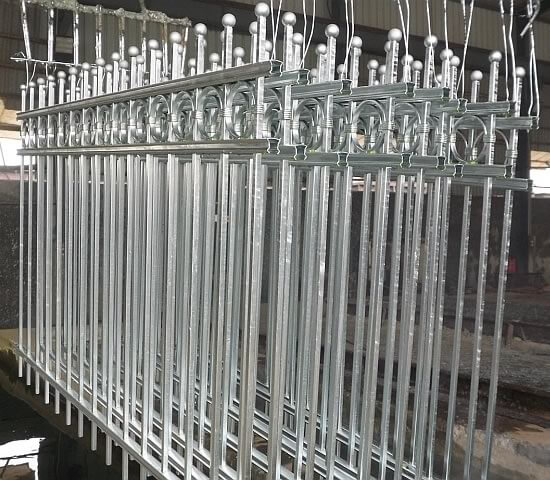 It is the process of coating iron, steel or with a thin zinc layer, by passing the metal through a molten bath of zinc at a temperature of around 860 °F (460 °C). When exposed to the atmosphere, the pure zinc (Zn) reacts with oxygen (O2) to form zinc oxide (ZnO), which further reacts with carbon dioxide (CO2) to form zinc carbonate (ZnCO3), a usually dull grey, fairly strong material that stops further corrosion in many circumstances, protecting the steel fence below from the elements. Galvanized steel is widely used in applications where rust resistance is needed, and can be identified by the crystallization patterning on the surface (often called a “spangle”).
Surface Preparation
Surface preparation is the most important step in the application of any coating. The galvanizing process for fences and carports has its own built-in means of quality control because zinc will not react with an unclean steel surface. The surface preparation step in the galvanizing process consists of three steps:
- Degreasing/Caustic Cleaning – A hot alkaline solution removes dirt, oil, grease, shop oil, and soluble markings.
- Pickling – Dilute solutions of either hydrochloric or sulfuric acid removes surface rust and mill scale to provide a chemically clean metallic surface.
- Fluxing – Steel is immersed in a zinc ammonium chloride solution to remove oxides and to prevent oxidation prior to dipping into the bath of molten zinc. In the dry galvanizing process, the item is separately dipped in a liquid fluxbath, removed, allowed to dry, and then galvanized. In the wet galvanizing process, the flux floats atop the molten zinc and the item passes through the flux immediately prior to galvanizing.
Galvanizing
During the true galvanizing step of the process,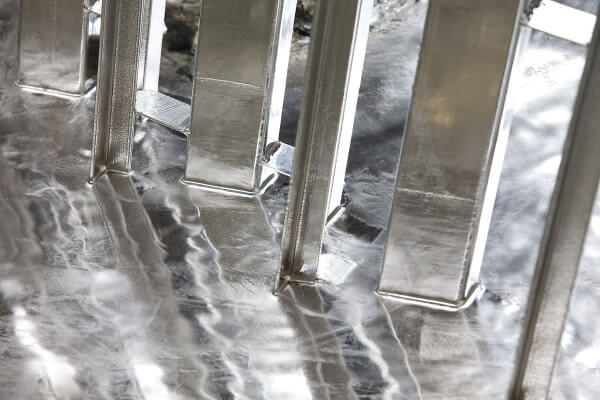 the article is completely immersed in a bath of molten zinc between 815-850 F (435-455 C). The chemistry of the bath is at least 98% pure zinc in accordance with ASTM B6. While immersed in the kettle, the zinc reacts with the iron in the steel to forma series of metallurgically bonded zinc-iron alloy layers, commonly topped by a layer of impact-resistant pure zinc.
As the steel is withdrawn slowly from the galvanizing bath, excess zinc is removed by draining, vibrating, and/or centrifuging. The metallurgical reaction will continue after the articles are withdrawn from the bath, as long as it remains near bath temperature. Galvanized items are cooled either by quenching in a passivation solution or water or by being left in open air.
Inspection
The inspection of hot-dip galvanized steel is simple and fast. 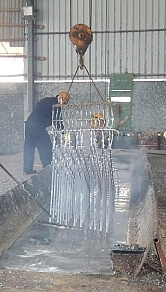 The two properties most closely scrutinized are coating thickness and appearance/surface condition. A variety of simple physical tests can be performed to ensure a perfect quality.
Galvanizing is used throughout various markets to provide steel with unmatched protection from the ravages of corrosion. A wide range of our steel products from wrought iron fences to carports and streetfurniture benefit from galvanizing’s superior corrosion protection properties.
Characteristics of Zinc
Galvanizing’s primary component is zinc. This vital metal is silvery, blue-gray in color, makes up an estimated 0.004% of the Earth’s crust, and ranks 27th in order of abundance. It is essential for the growth and development of almost all life: Between 1.4 and 2.3 grams of zinc are found in the average adult, and the World Health Organization has recommended a daily intake of 15 milligrams. Numerous consumer products including cold remedies, sunscreens, diaper creams, and nutritional supplements contain beneficial amounts of zinc, primarily in the form of zinc oxide.
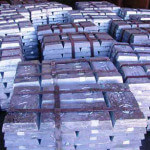 To the eye, galvanized steel is blue-gray, but it is also “green.” The zinc and galvanizing industries work to promote sustainable development by enhancing zinc’s contribution to society and ensuring its production and use are in harmony with the natural environment and the needs of society, now and in the future.
Zinc, as it is used in galvanizing, is a healthy metal, completely recyclable. The energy used to melt zinc is inversely related to the amount of zinc recycled. Galvanizing delivers incredible value in terms of protecting our infrastructure. Less steel is consumed and fewer raw materials are needed because galvanizing makes our fences, carports and street furniteure last longer. Over time, galvanizing helps maintain steel fabrications’ structural integrity: galvanized structures are safer. Additionally, because galvanized steel requires no maintenance for decades, its use for fences and carports is excellent. Selecting galvanized steel for your wrought iron fence project makes a significant contribution to a company’s profitability.